




Review: Overview of the Greenness' Metrics used to Evaluate Analytical Methods
Amanda Mohr, Brendha Lang Camboim, Andreas Sebastian Loureiro Mendez, Cássia Virginia Garcia,
Martin Steppe
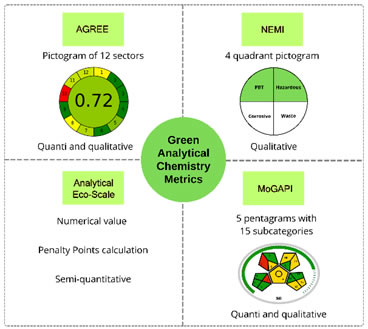
The main goal of Green Analytical Chemistry (GAC) is to reduce the use of hazardous chemicals and waste generation in analytical procedures without compromising method performance. Over the years, several metrics tools were introduced to measure the environmental impact and greenness of analytical procedures. In this context, this paper aims to present an overview of the most used GAC metrics in analytical chemistry, highlighting their criteria, advantages, disadvantages, and comparing their applicability. After extensive research, the metrics selected to be addressed were: National Environmental Method Index (NEMI), Analytical Eco-scale, Modified Green Analytical Procedure Index (MoGAPI), and Analytical GREEnness Metric (AGREE). NEMI is one of the oldest GAC metrics, describing the greenness of the method by a simple pictogram. Analytical Eco-Scale is based on subtracting penalty points from a total score of 100 points. MoGAPI uses a pictogram made up of fifteen categories and a total score to display the greenness of the analytical procedure. AGREE is represented as a circular pictogram divided into 12 parts, where each part corresponds to a principle of GAC. Each discussed metric has its own advantages and disadvantages; however, AGREE stands out as the most widely used and comprehensive GAC metric, applicable to several techniques. Although time-consuming, ideally, the best approach is to apply all metrics in combination to gain as much information as possible.
Read more